
Practitioner packet
For clinicians and clinic teams
2026
For clinicians and clinic teams
2026
For clinicians and clinic teams
Capture the full arc of care once, follow outcomes over time, and produce de-identified reports when a board, payer, referrer, or your own team needs an answer.
Arcametric runs beside the records your clinic already keeps, structures the full arc of care, and keeps patient names, dates of birth, and contact details in the clinic.
Two design choices set it apart: how much of the care arc becomes structured data, and where patient identity stops. The rest of this packet follows from those two facts.
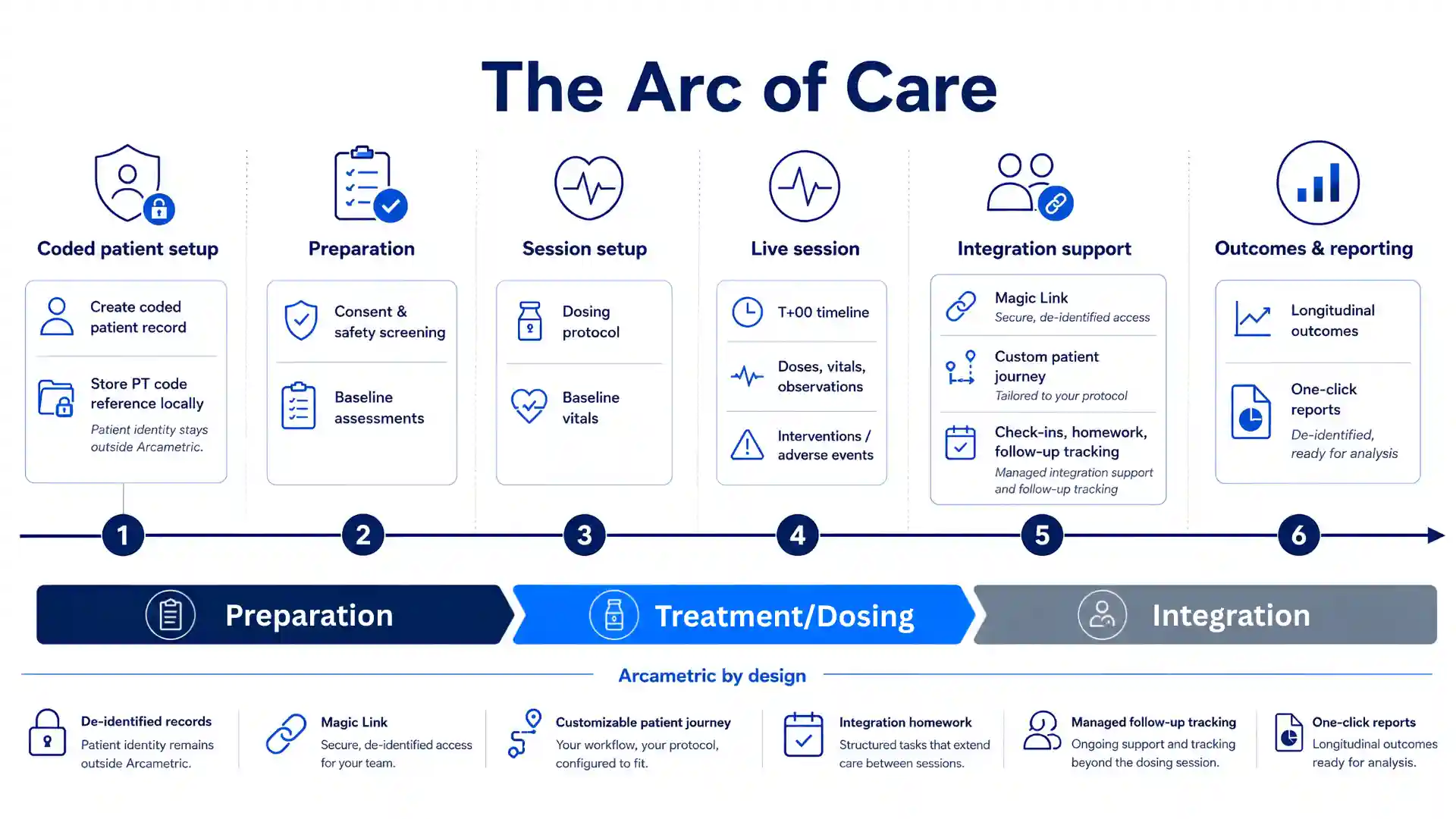
Your record should be usable when you need it, not rebuilt after the fact. Arcametric keeps preparation, treatment, integration, follow-up, and outcomes linked in one structured longitudinal record.
Check-ins and validated measures stay connected to the same coded record, so you can review what happened without piecing together notes, spreadsheets, and separate forms. The same structure can support follow-up, reports, benchmarking, and analysis without re-entering the same information for each use.
| What you can do | What that means in the room |
|---|---|
| Document | Capture each stage once in a structured longitudinal record instead of re-entering the same information later. |
| Protect | Keep patient names, dates of birth, and contact details in the clinic while coded records support review. |
| Measure | Track validated measures over time in the same longitudinal record. |
| Track | Keep follow-up and integration activity visible across the care arc. |
| Standardize | Use governed structured fields and recognized medical vocabularies where applicable. |
| Benchmark | Compare outcomes across eligible records. The usefulness of those comparisons grows as more outcomes are logged and network participation expands. |
Generate the report from the record as it was captured instead of rebuilding the story from notes. Current reports are produced from coded, structured records and are de-identified.
| Report | What it shows |
|---|---|
| Progress report | Longitudinal outcomes and check-in trends for one patient. |
| Insurance report | Structured session and outcome context for payer review. |
| Referral-provider report | Structured treatment response and follow-up for the referring provider. |
| Session timeline | The full session chronology, anchored to session launch. |
| Follow-up report | Check-in completion and longitudinal follow-up activity. |
| Audit and compliance report | Consent, safety, and documentation history with timestamps and coded references. |
| Adverse-event report | Structured adverse-event details, timing, severity, and related documentation. |
Patients use a secure Magic Link to complete check-ins without downloading an app or creating a password. Their responses and validated scores stay linked to the same coded record, so you can see trajectories over time without entering the same data twice.
During an active treatment session, you can mark a potentially meaningful moment and add structured experiential observations from a governed list. These observations remain distinct from safety events, preserving what was observed without asserting what it meant.
What we do not claim. Arcametric documents and surfaces. It does not direct care, and it makes no claim to improve clinical outcomes. It structures and de-identifies what practitioners record; it does not validate that a recorded observation is clinically meaningful.
| Boundary | What that means |
|---|---|
| Not clinical decision support | Arcametric does not prescribe, diagnose, recommend dosages, or replace prescriber judgment. Reference information may support documentation where enabled. |
| Not a regulatory filing system | It does not replace controlled-substance reporting or other regulatory submissions. Your practice still handles those obligations. |
| Not an EHR | It does not do scheduling, primary charting, billing, or claims. It works alongside the EHR you already use. |
The demo uses live application screens and de-identified sample records. Watch it on demand with no signup, or request access to review the workflow and sample reports. We will surface limitations directly.
Next, see how much documentation time structured capture gives back in the Time Savings Analysis at arcametric.com/time-savings-analysis.
Contact: hello@arcametric.com · app.arcametric.com/pricing
Arcametric
arcametric.com
© 2026 Arcametric