The integration gap

A dosing session ends in a day. Integration runs far longer.

Integration is the third phase of psychedelic-assisted therapy, covering the weeks and months after a dosing session when a patient works out what happened and turns it into something durable. Preparation and dosing are measured in hours. Integration is the longest phase of the arc, and the least measured.

What the field already does

Oregon put the days after dosing into its rules

Ask anyone who does this work and they describe the weeks after a session as the stretch where treatment either holds or quietly comes apart. Ask for the data and the conversation gets shorter.

One regulator has already written the window into law. Oregon's psilocybin services rules require a licensed facilitator to follow up with a client within 72 hours of an administration session, and to offer integration sessions. The duty is to reach out and offer, not to deliver care. That is narrower than it first sounds, and it still matters, because a state put the days after dosing into the legal floor of how this treatment gets delivered.

What the field lacks is not conviction. The field lacks measurement.

Why the phase resists study

Most integration concepts have no broadly adopted code

Medicine agrees on codes for a great many things. One code names the substance, another the dose, another the route, another the diagnosis. Those codes are what let one clinic's records mean the same thing as another clinic's records, which is what makes research possible at all.

We mapped the vocabulary this field actually has and published the result. Most of the concepts on that map carry no broadly adopted code. Whether a person acted on an insight or only reflected on it. Whether they are functioning at work and at home. Whether the change visible in week two was still there in week eight. Each clinic writes those in its own words, and no two records line up.

Give the ineffable a shared vocabulary.

The experiences that matter most in this phase are the hardest to write down. A patient describes unity, or the sense of a self dissolving, or a realisation that arrives whole, or an experience that defies language at all. Written as free text, that description reaches one reader once. It does not travel.

Arcametric replaces the free text with a governed catalog. A practitioner selects from a fixed list of experiential observations rather than typing a description, so the same event carries the same meaning at every site. Acute physical effects sit in a separate class, so recording nausea never manufactures an adverse event.

The record refuses to say what any of it meant. Interpretation stays with the clinician, and that restraint is the point.

See the coding landscape, which maps every concept and marks which ones carry a code.

The honest limit

A structured record holds what memory loses

A record cannot do integration work. A record can keep the work from happening blind.

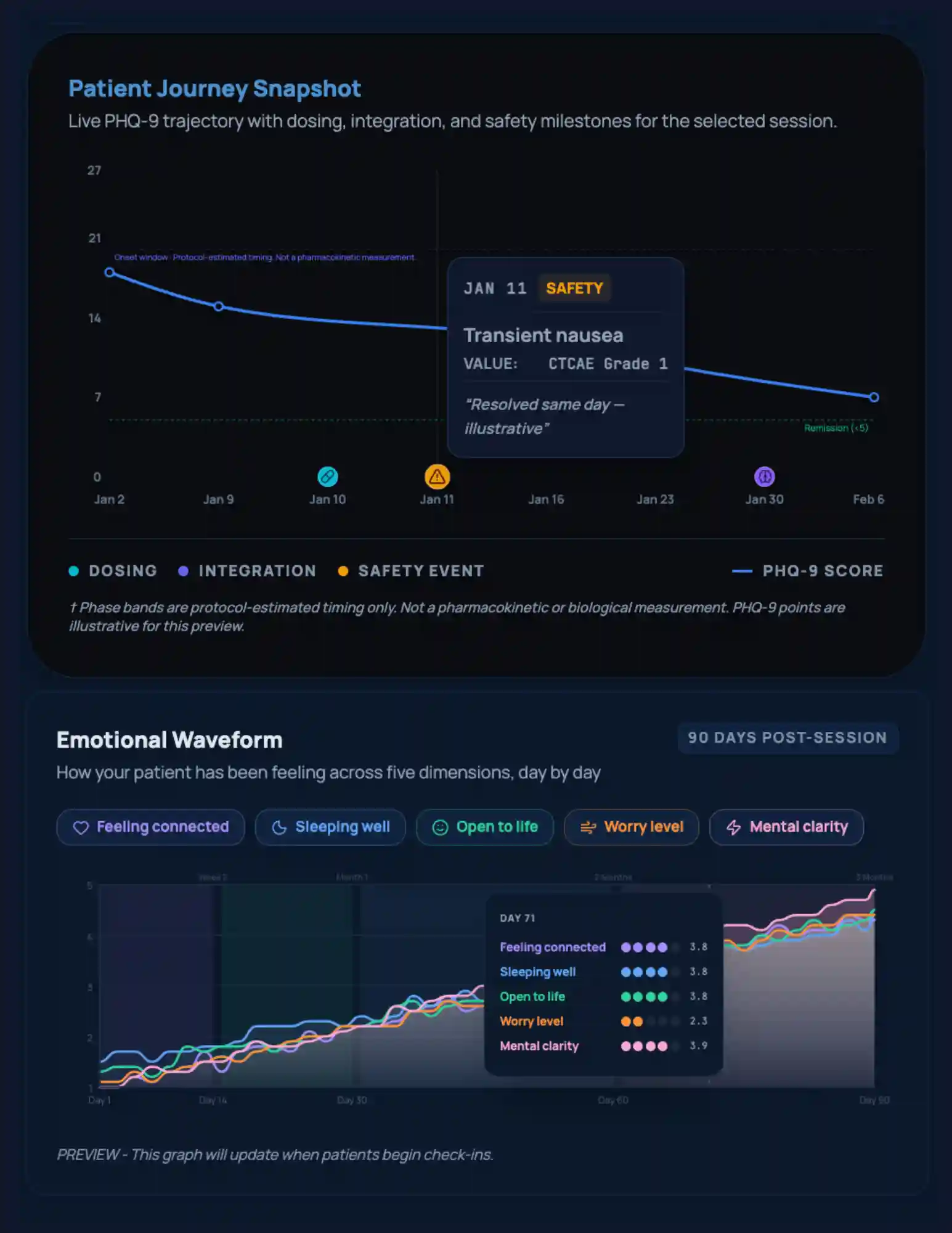
Consider the sharpest reason that matters. In the days after a session many patients feel markedly better, as mood lifts and relief arrives. That early lift is hard to tell apart from durable change, because both look the same on a form. Read a score in week two and you may be reading the tail of the session rather than the state of the patient. The difference becomes visible weeks later, which is exactly the stretch nobody is measuring.

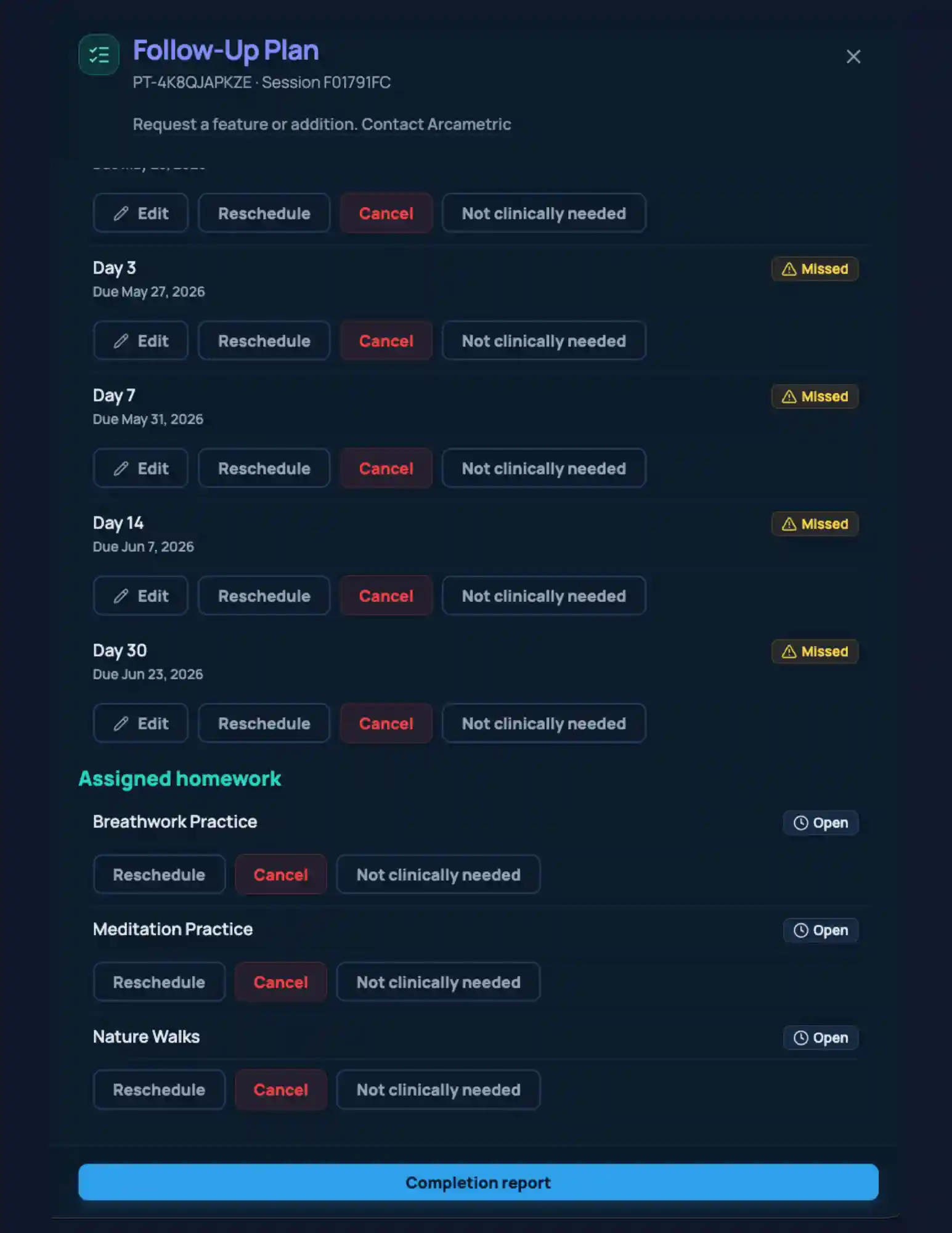
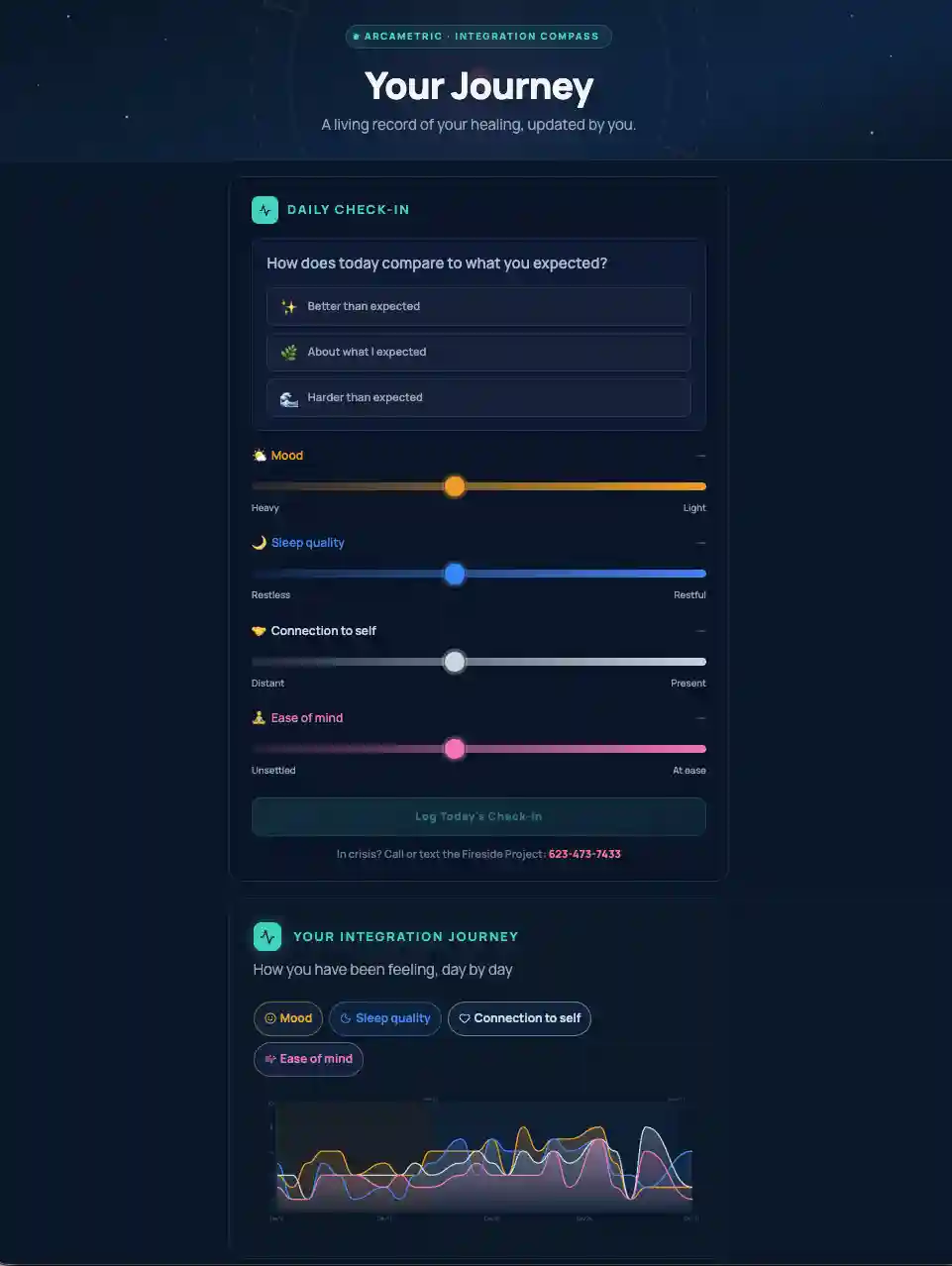
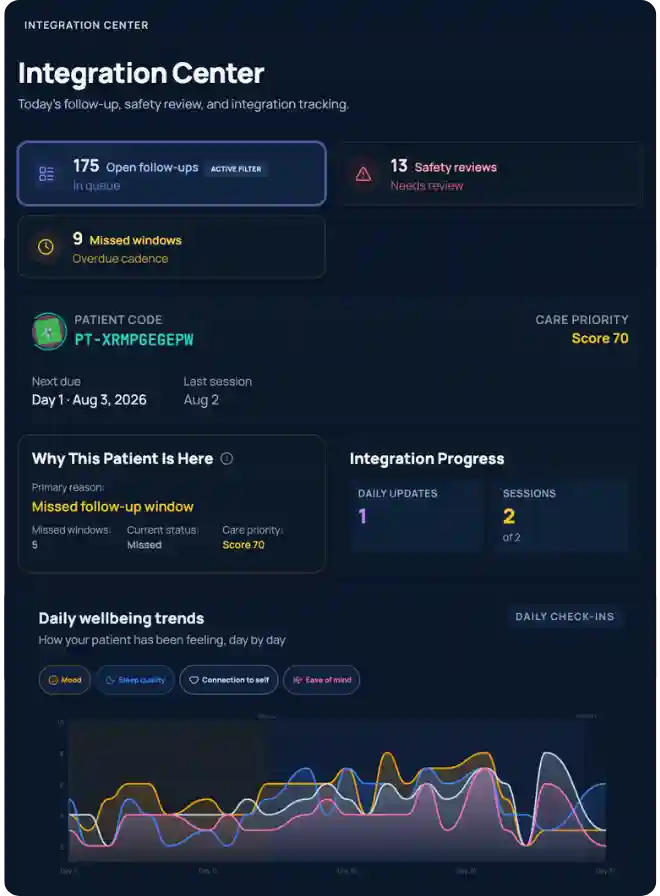
A record can capture a moment during the session, timed precisely, and still hold it three weeks later when the conversation turns to what that moment meant. A record can carry a follow-up plan set for one patient, showing which checkpoints happened and which did not. A record can give a patient a way to say how the week is going that takes seconds rather than a form.

None of that interprets anything, because interpretation is clinical work. A clinician who can see what happened, and when, still sits in a different position than one working from memory and a folder of loose notes.

Side by side

The dosing day has standard codes. The weeks after do not.

The gap is easiest to see laid out. Everything in the left column has an agreed format. Almost nothing in the right column does.

Captured on the dosing dayCaptured in the weeks after
Substance, dose, and route, in standard codesUsually nothing in a standard format
Vital signs at known intervalsWhatever the patient mentions at the next appointment
Adverse events, coded and reportableDifficulties that surface after discharge, often unrecorded
Session duration, to the minuteWhether follow-up happened at all
Who was in the roomWhether the outside therapist ever learned what occurred
What buyers ask

Few basic questions about this phase have settled answers

How long does the integration phase last?

No standard exists. Protocols commonly schedule structured integration sessions across the first several weeks, and clinicians often describe the work continuing well past that. The absence of a standard is part of the problem this page describes.

Why do patients drop out after a dosing session?

Several reasons appear repeatedly in practitioner accounts: feeling resolved immediately afterward and seeing no reason to return, cost, and simply never booking the next appointment. Few clinics record dropout reasons in a consistent way, so the relative weight of each is not well established.

Document integration inside the clinical record.

See how integration support works inside the clinician workflow, or see the reports it produces from the record as captured.